
This Startup Just Raised $10M For Its Water Based Fat Replacer
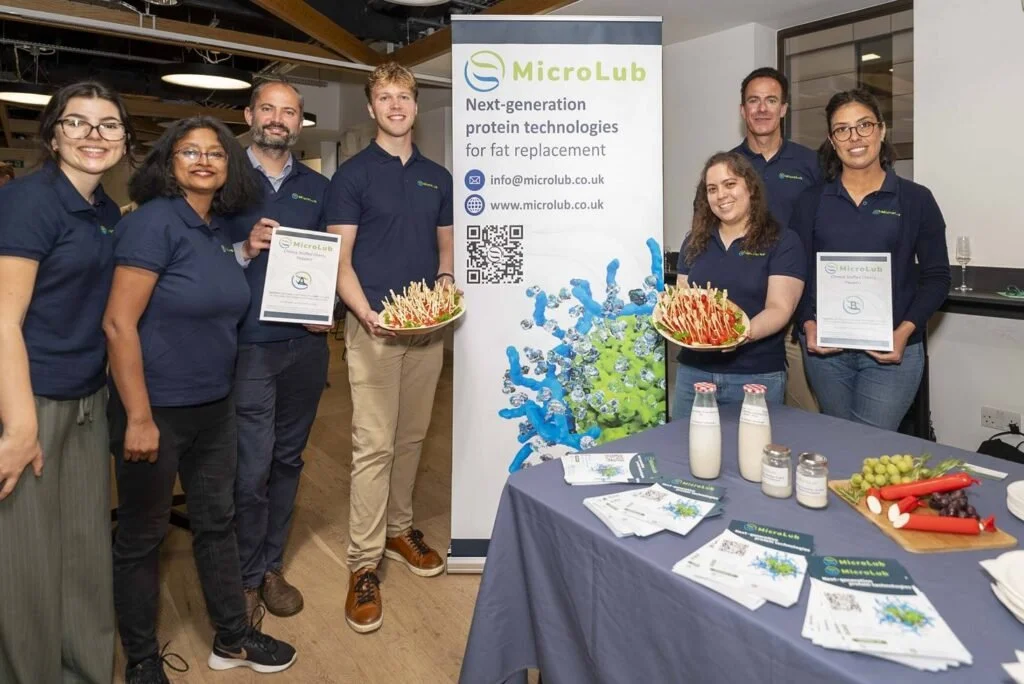
A gritty protein shake and a reduced-fat cream cheese that feels thin share the same underlying flaw, and that flaw is friction in the mouth. MicroLub, a University of Leeds spinout, just closed a $10 million round to scale one ingredient platform aimed at both, and its pitch treats the texture problem founders building plant-based companies know well as one the entire reformulating food industry now shares.
Northern Gritstone led the round with £4 million, more than half the total, and every investor from MicroLub's 2024 round came back. The capital will fund US and Asian expansion and more than double headcount over 18 months, with the aim of turning customer trials into commercial agreements. It brings total funding to roughly $14.5 million after a £3.5 million seed in October 2024. CEO David Peters previously ran Oatly's UK business.
The ingredient grew out of Professor Anwesha Sarkar's lab, where the team treated the dry, puckering sensation of plant protein as a lubrication failure. In a 2023 Nature Communications paper, they turned pea and potato protein into microgels made of 85% to 95% water and tested them on a 3D-printed surface built to mimic a human tongue, down to the papillae. The microgels cut boundary friction by an order of magnitude compared with the native protein and matched the lubrication of an oil-in-water emulsion that was 20% oil.
MicroLub's commercial version draws on a toolbox of plant and dairy proteins, including pea, soy, oat and fava bean, and coats the microgels with polysaccharides in calibrated ratios. Which protein and coating it uses depends on each application's cost and supply chain. MicroLub says manufacturers can cut fat and calories by up to 75% in some formulations.
One ingredient, three pitches
The same microgel now travels under three pitches. The Nature paper opens with the emissions gap between animal and plant foods and frames astringency as a barrier to plant protein adoption. The funding announcement leads with tighter regulation, changing eating habits and GLP-1 drugs, and it groups plant-based development with fat reduction and protein fortification as reformulation moves that tend to cost taste and texture. Peters told Food Ingredients First that he doesn't see MicroLub as a GLP-1 ingredient and sees a broader opportunity.
The pitches hold together because the mechanism is shared. Adding protein raises friction, stripping out fat raises it too, and plant proteins raise it more than dairy proteins do, according to the Nature paper. MicroLub also targets personal care, where the same friction physics shapes how a lotion feels on skin.
Plant-based dairy shows the same tension. In NECTAR's Taste of the Industry 2026 blind tests, 2,183 omnivores in New York and San Francisco rated 98 dairy-free products against dairy benchmarks. Green Queen's report on the study notes that protein was the only macronutrient significantly tied to both purchase intent and liking, yet adding it could drag down performance, most visibly in cream cheese and ice cream. More fat or sugar per calorie didn't reliably lift scores, and NECTAR director Caroline Cotto described richness as a matter of mouthfeel, flavor depth and the absence of thin, watery notes. Laid next to MicroLub's promise of more protein and less fat without a loss in mouthfeel, those findings read like a product brief.
Other startups are working on fat from the opposite end. Nourish Ingredients received a FEMA GRAS determination in 2025 for Tastilux, its fermentation-derived fat, and Melt&Marble, which raised a €7.3 million Series A in December 2025, reached self-affirmed GRAS status for its MeltyMarble food fat in March 2026. Those companies build new fat molecules, and MicroLub rebuilds the feel of fat from protein and water.
What the GLP-1 grocery data adds
The announcement's GLP-1 reference has hard numbers behind it. A Cornell study in the Journal of Marketing Research found that US households cut grocery spending by 5.3% within six months of starting a GLP-1 medication, with savory snack spending down about 10%, and Cornell's release noted that product formulations may need to change. The share of US households with a GLP-1 user rose from 11% in late 2023 to 16% by mid-2024, according to the same research.
Our read is that the broader reformulation wave is the market underwriting MicroLub's next stage. That helps founders building plant-based companies, because a texture tool built for the whole food industry reaches their aisle without their category having to fund it.
MicroLub has not named customers or a launch date, though Peters told Food Ingredients First that the new money lets it work more closely with customers of every size. He also said products built on a solid fat network or on fat-soluble flavors are more challenging, while blind trials across several categories have left tasters unable to tell MicroLub products from full-fat originals. The 2023 paper itself left human sensory trials for future work.
The next signal to watch is the first commercial supply agreement out of those customer trials and the shelf it lands on. A plant-based cream cheese and a reduced-fat dairy cream cheese would prove the same thing, because in MicroLub's lab they were always the same friction problem.
RECENT POSTS
Get the newsletter.
The funding rounds, founder moves, and industry shifts you need to know in plant-based and sustainability. Plus event invites and founder stories worth reading.