
Meet Heather Mills' New Brand
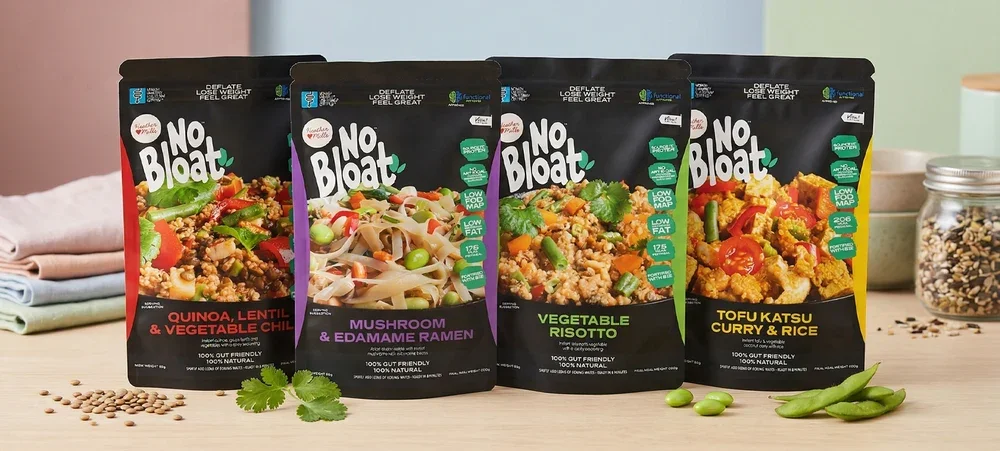
Heather Mills spent three decades building plant-based alternatives to meat, fish and dairy. Her newest company sells meals designed around what a plant-heavy diet does to some people’s digestion.
"So I researched why some people go plant based and they bloat," she told VEGPRENEUR, holding a foil pouch of lentil, tofu and vegetable hash at her booth. "When you’ve eaten really badly most of your life, or something happens like Lyme’s disease, it can destroy the microbiome so you can’t digest things."
The product is No Bloat, a range of freeze-dried meals certified by Monash University as low FODMAP. The range is entirely plant-based. Almost nothing about how it goes to market says so.
What the lapsing data shows
Faunalytics’ study of current and former vegetarians and vegans surveyed more than 11,000 US adults and found former vegetarians and vegans outnumbering current ones by more than five to one, at 10% of the population against 2%. Over half of those who lapsed, 53%, had lasted less than a year. The researchers’ own conclusion was that the movement was doing far better at adoption than at adherence.
Asked for the primary reason they stopped, 32% of former vegetarians and vegans said they were unsatisfied with the food and 26% cited health. The same study is a check against overclaiming here. When those respondents were asked whether they had developed any of 14 specific conditions, 71% reported none, and no single condition affected more than 10% of them apart from iron deficiency at 11%. Bloating is not why most people quit. It sits inside the two reasons that account for most lapsing, and it is one of the few a manufacturer can engineer against directly.
The enzyme nobody has
Legumes are, in Monash University’s phrasing, a great non-animal protein source for vegetarians and vegans. The same Monash guidance notes that legumes can be troublesome on a low FODMAP diet because they run naturally high in oligosaccharides, including galacto-oligosaccharides and fructans.
Those oligosaccharides are the reason. Peas, lentils, chickpeas and faba beans carry raffinose family oligosaccharides, and humans lack the alpha-galactosidase needed to break them down, so they travel to the large intestine and get fermented by gut bacteria instead. The crop that solved the category’s protein problem and the crop that causes the discomfort are the same crop. For most eaters that stays mild or fades. A smaller group never gets past it.
Join the VEGPRENEUR WhatsApp Community
Measuring the pulses instead of removing them
The obvious formulation move would have been to strip the legumes out. No Bloat kept them and portioned them. Lentils appear across the launch range, including a quinoa and lentil chilli and a pasta and lentil bolognese, dosed to what the brand’s Gulfood announcement describes as precise tolerances authenticated by Monash. Monash’s guidance allows for exactly this, advising that legumes need not be avoided outright and that canning, boiling and draining pull some of the oligosaccharides out.
The rest of the credibility comes from third parties. No Bloat says its meals were the first food products the Functional Gut Clinic tested and found to produce no negative gut reactions. Physician Michael Klaper, who assessed the range, gave the brand a line it now runs on its site, calling the meals "very light on the tummy."
[PULL QUOTE: "So I researched why some people go plant based and they bloat." — Heather Mills, founder, No Bloat]
The positioning choice
Mills bought the company that became VBites in 2009 and has since added a cosmetics line, an algal oil brand and an online ethical store. No Bloat leads with none of that. The brand’s own audience breakdown names people with IBS, busy professionals and students, athletes, women going through perimenopause and menopause, and travellers before it reaches plant-based eaters, and the site states plainly that the range happens to be 100% plant-based while not being positioned exclusively for vegans.
A founder with three decades of movement credibility decided the category entry point is a symptom rather than an identity. The formulation does not change. The set of people who will pick it up does.
From administration to a second act
VBites called in administrators in December 2023, and Mills bought the assets back the following month in a rescue deal Interpath Advisory valued at £1m. Talking to Food Manufacture at the time, she said a "version 2.0" of plant-based food was already developed and would help people attempting a flexitarian or plant-based transition achieve it more easily. Two years on, that description fits No Bloat rather than anything in the VBites freezer aisle.
The proof of concept came at Anuga in October 2025. No Bloat was placed in the meat hall, which Mills’ own account of the show calls being the black sheep, and it drew distributor interest from five countries stretching from Iceland to Peru. Buyers came over, by her account, because many of them had gut problems themselves. The brand went on to Gulfood in Dubai in January 2026.
Watch whether the clinical framing travels. If Monash certification moves more units than a plant-based claim does, the founders building in this category will notice, and the next round of positioning will follow the certification rather than the diet.
Sources
RECENT POSTS


Get the newsletter.
The funding rounds, founder moves, and industry shifts you need to know in plant-based and sustainability. Plus event invites and founder stories worth reading.